Showing posts with label DePatie-Freleng Enterprise. Show all posts

Thursday, July 3, 2014

Pontoffel Pock, Where are You?

Pontoffel Pock, Where Are You? is an animated musical television special written by Dr. Seuss, directed by Gerald Baldwin, produced by DePatie-Freleng Enterprises, completed in 1979 and first aired on ABC on May 2, 1980. This was one of the final cartoons done at DePatie-Freleng as the studio would be sold to Marvel Comics and become Marvel Productions in 1981. The songs are by Joe Raposo.

In this special, Pontoffel Pock gets fired from his job at a pickle factory, wishing he could get away from it all and receives a magical piano from jolly fairy McGullicuddy. Pock embarks on a series od loopy misadventures as the flying piano enables him to travel around the world. In Casbahmopolis, which is in the Middle East, Pontoffel catches his eyes on a famous eyeball dancer named Neefa Feefa, who dislikes her job of dancing for the Sultan, and like Pontoffel, wants to get away from it all. Unfortunately, Pontoffel is separated in several places and he has to go back to Neefa Feefa. With the help of the fairies who sang, "Pontoffel Pock, Where The Heck Are You?", they bring Pontoffel and Neefa home together on the piano and for proving his worth, Pontoffel is rehired as a Dill Pickle Factory employee along with Neefa Feefa.

The special features the voices of Sue Allen as Neefa Feefa. Ken Lundie as Higbee. Don Messick as Humboldt. Wayne Morton as Pontoffel Pock. Joe Raposo as Gil Gickler the Pickle Factory President. And Hal Smith as both McGillicuddy and Good Fairy-in-Chief.

Monday, June 30, 2014

Halloween is Grinch Night

Halloween is Grinch Night is a 1977 Halloween musical TV special and prequel to How the Grinch Stole Christmas!. It won the 1977 Emmy Award for Outstanding Animated Program. It premiered on ABC on October 29, 1977.

In this special, the evil Grinch who stole Christmas is back to steal Halloween! When the sour-sweet wind starts blowing again, the Whos in Whoville retreat to their homes because they know the Grinch will soon be a'prowlin'. It's Grinch Night and young Eukariah Who has to make a trip to the Euphemism when the wind blows him away to a confrontation with the gruesome Grinch. Eukariah decides that Grinch must be stopped from terrorizing the Whoville, so he faces his fears and confronts the Grinch and his spooks in the surreal imaginary filled with numerous monsters. In the end, the Whos celebrate the little Who's courage in preventing the Grinch releasing the Paraphernalia Wagon's full horrors on their town and up in the mountains the Grinch, who is hauling the wagon home himself, hoping that one day there will be another Grinch Night when the Sour-Sweet Wind blows once more.

The special features the voices of Hans Conried as the Grinch and the narrator. Gary Shapiro as Eukariah Who. Hal Smith as Josiah. Irene Tedrow as Mariah. Jack DeLeon as Sergeant Samuel McPherson. Thurl Ravenscroft as the singing monsters. And Henry Gibson as Max in the singing part of "What Am I Doing Here?"

Sunday, June 29, 2014

The Hoober-Bloob Highway

The Hoober-Bloob Highway is an animated musical special written by Dr. Seuss and produced by DePatie-Freleng Enterprises for CBS in 1975. The special is a musical and features songs written by Dr. Seuss and composed by Dean Elliott, which is the last special to feature music, and is the first DFE Dr. Seuss special not to have been based on any of Geisel's books. This special would be the last time to be aired on CBS and produced by A Cat in the Hat Productions like the other five Dr. Seuss animated shorts. Bob Holt voices Mr. Hoober-Bloob while Hal Smith does the Additional voices are the only cast in the Dr. Seuss special.

Mr. Hoober-Bloob, a dispatcher of newborn children from some location in space, is preparing to send a new child down his highway to Earth, but first, he gives a child, who he refers to as Bub, a chance to decide for himself whether he wants the life of a human. Mr. Hoober-Bloob shows him the realistic problems and pleasures that people face in life. The story suggests that while things may be pretty bad, but there's always something to be thankful for. With the help of a lute with arms and legs that often breaks into fast-paced solos, which annoys Mr. Hoober-Bloob, his explanations are often accompanied by musical vignettes of the baby, depicted as a pre-adolescent boy in an unusual situation that accompanies the song. Eventually after the "Answer Yes or No", the baby makes its decisions, and Mr. Hoober-Bloob excitedly pushes it down the Hoober-Bloob Highway at last.


Saturday, June 28, 2014

Dr. Seuss on the Loose

Dr. Seuss on the Loose is an animated musical television special, cartoon first airing on CBS on October 15, 1973, and hosted by The Cat in the Hat who appears in bridging sequences where he introduced three animated adaptions of Dr. Seuss children's stories including The Sneetches, The Zax, and Green Eggs and Ham. Allan Sherman reprises his role as the voice of The Cat in the Hat from the 1971 TV special. This special was the final project Sherman worked on before his death.

First in The Sneetches, some of the Star-Belly Sneetches have stars on their bellies and some of the Plain-Belly Sneetches don't have their stars. With the help of Sylvester McMonkey McBean, the Fix-It-Up Chappie, the Sneetches learned a valuable lesson either they have a star or not from McBean's Star On and Star Off Machines. Then in The Zax, the North-Going Zax and the South-Going Zax stand respective headings around each other because both are stubborn and none of them went any directions until the highway overpass is built around them. And finally in Green Eggs and Ham, Sam-I-Am tries to convince a grumpy grouch guy to eat his favorite dish, but he refuses to sample them. He gets really grumpy wherever Sam-I-Am follows repeating his respond, "I would not like them here or there. I would not like them anywhere!" in various locations from a house, a box, a car, a tree, a train, in the dark or the rain, and on a boat. Along with a mouse, a fox and a goat, but the fox in the special was chased by the fox hunters. Finally, the grouchy guy gives into Sam's pestering and sample green eggs and ham, which he certainly does like them after all.

The special features the voices of Allan Sherman as The Cat in the Hat. Hans Conried as the narrator, North-Going Zax and South-Going Zax. Paul Winchell as Sam-I-Am, Grouchy Guy, and the Sneetches. And Bob Holt as Sylvester McMonkey McBean and the Sneetches.
  

Friday, June 27, 2014

The Lorax

The Lorax is a 1972 animated musical television special produced by DePatie-Freleng Enterprises. It first aired on CBS on February 14, 1972 based on the book by Dr. Seuss. It last aired on July 30, 2005 as the airing of ABC. In this special, a ruined industrialist who is known as The Once-ler tells his tale of his environmentally self-destructive greed despite the warnings of an old forest creature with a yellow mustache called The Lorax, who speaks for the Truffula Trees. When the entire forest was chopped down by the Once-ler and his family, they made Truffula Trees into soft things called Thneeds. But they did not hear The Lorax' wise warnings as he protect. In addition there are also animals in the forest which are the bear cubs called the Bar-Ba-Loot Suits, the birds called the Swamee Swans, and the goldfish called Humming Fish.

The special features the voices of Bob Holt as The Lorax and The Once-ler. Athena Lorde as Miss Funtzler and Miss O'Schmunsler. And Harlen Carraher as The Boy who hears the Once-Ler's story and uses the Truffula Seed to grow back the forest before the special ends.

Thursday, June 26, 2014

The Cat in the Hat

The Cat in the Hat is an animated musical television special first aired on CBS on March 10, 1971, based on the 1957 Dr. Seuss children's book, and produced by DePatie-Freleng Enterprises. With the voices of Allan Sherman and prolific vocal performer Daws Butler, this half-hour special is a loose adaption with added musical sequences.

Instead of following the adaption from the Dr. Seuss book, The Cat has lost his Moss-Covered Three-Handled Family Grudunza so the kids marked the letters and number in the entire house wherever they checked there during the song of "Calculatus Eliminatus." The fish who didn't have a name in the Dr. Seuss book is named Karlos K. Krinklebein who demands the Cat to leave and accuses him of not being a real cat and his hat of not being a real hat. Then Thing One and Thing Two emerged from the pink box to aid the Cat singing that they can find "Anything Under The Sun." And The Cat asserts legitimacy by singing his name in several languages including Chat Chapeau in French, El Gato Sombrero in Spanish, Katze Hut in German, Gwonka Bonkequank in Eskimo, and Shapka in a Shylapa in Russian. And like in the book, The Cat cleans up the entire house he and the kids made using the motorized vehicle just before their mother returns.

The special features the voices of Allan Sherman as The Cat in the Hat. Daws Butler as Karlos K. Krinklebein. Tony Frazier as the Boy. Pamelyn Ferdin as Sally. Gloria Camacho as Mother. Thurl Ravenscroft as Thing one. And Lewis Morford as Thing Two.

Wednesday, April 2, 2014

The Pink Panther

The Pink Panther is the main and title character in the opening and closing credit sequences of every film in The Pink Panther series except for A Shot in the Dark and Inspector Clouseau. His popularity spawned a series of theatrical shorts, merchandise, a comic book, and television cartoons. He starred in 124 short films, 10 television shows and three prime time specials. The animated Pink Panther character's initial appearance in the live action film's title sequence, directed by Friz Freleng, was such a success with audiences and United Artists that the studio signed Freleng and his DePatie-Freleng Enterprises studio to a multi-year contract for a series of Pink Panther theatrical shorts. One of the Pink Panther shorts, The Pink Phink, won the 1964 Academy Award for Animated Short Film, and all of the animated shorts utilized the distinctive jazzy theme music composed by Henry Mancini for the 1963 feature film, with additional scores by Walter Greene or William Lava.

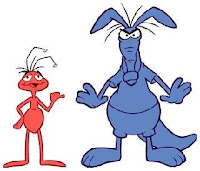
Other DePatie-Feleng Enterprises that go with The Pink Panther are The Inspector, the 1960s theatrical cartoons released through United Artists. The titular character is based on Jacques Clouseau, a comical French police officer who is also the main character in the Pink Panther series of films and is voiced by Pat Harrington, Jr. And in The Ant and the Aardvark, the cartoon follows attempts of a blue aardvark named Aardvark, to catch and eat a red ant named Charlie, usually doing so by inhaling with a loud vacuum cleaner sound.  Those 17 theatrical short cartoons were released by United Artists from 1969 to 1971. It stars voice of John Byner as both Aardvark and Charlie.